

Asset Allocation
Jun 4, 2026
Policy Regimes versus Economic Regimes
Policy regimes do not map cleanly to economic outcomes, but many historical episodes have shades of similarity that can help to analyze regimes and build more resilient portfolios. Policy impacts the economy, but policy regimes and economic regimes are not interchangeable. The dictates of policy often sound like clean breaks, while economic realities blur across the boundaries. Luckily, this ambiguity can be an advantage. Instead of treating policy regimes like the zero interest rate policy (ZIRP) ...
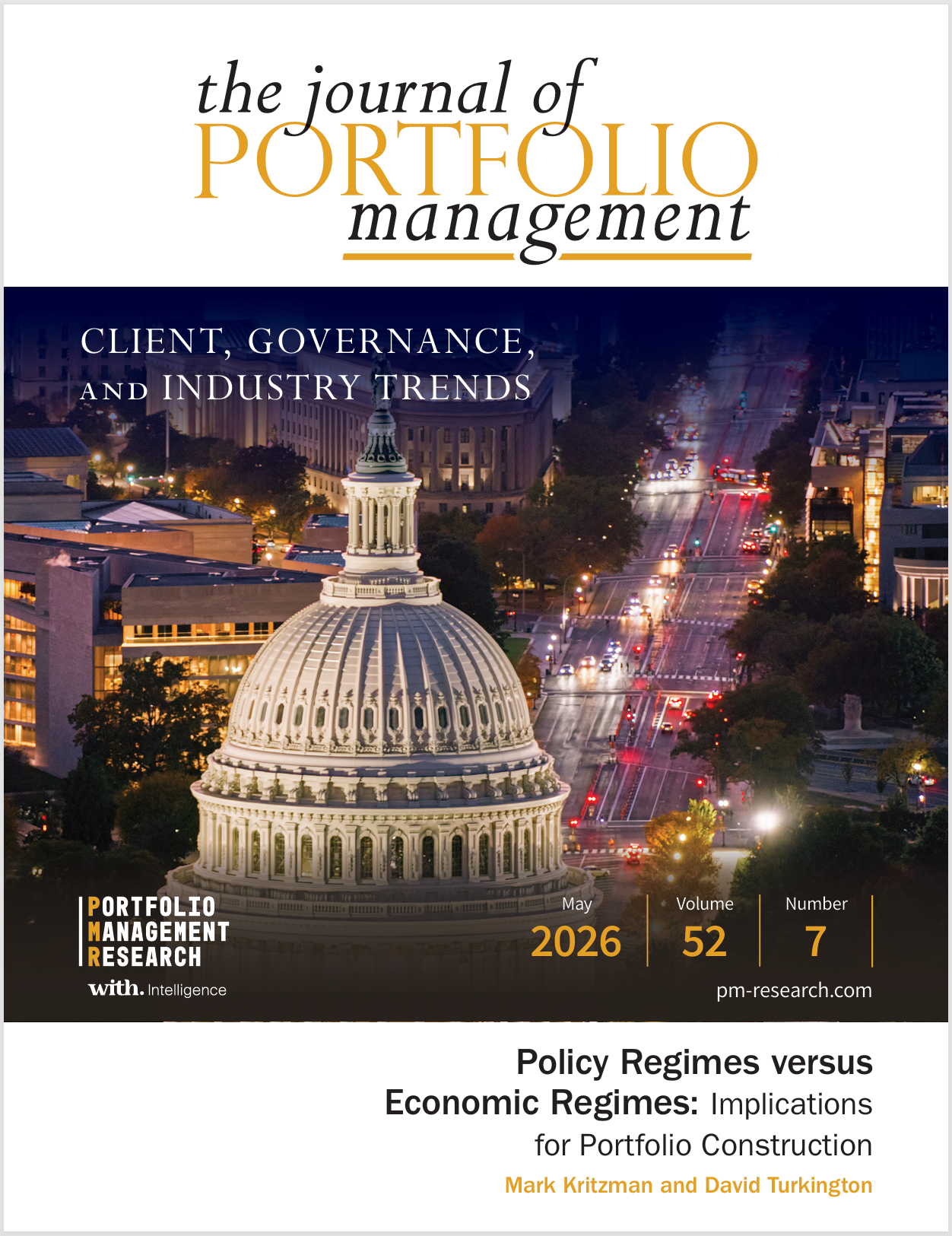
Nov 20, 2023
Portfolio Construction When Regimes Are Ambiguous
By Mark Kritzman, Cel Kulasekaran, and David Turkington. We introduce a more flexible way to forecast risk and return based on the most relevant historical periods. As economic regimes shift, investors who choose to adapt must build portfolios that match their evolving view of the future. Forecasts of asset risk and return should account for regime-specific trends. The question is how to implement this idea in practice. Typically, an analyst will find every time an economic indicator like inflation ...

Mar 28, 2022
The Role of Cryptocurrencies in Investor Portfolios
By Megan Czasonis, Mark Kritzman, Baykan Pamir, and David Turkington. Published in the Journal of Alternative Investments, Spring 2022. What is the role and diversification potential of cryptocurrencies from a total portfolio perspective? Growth engine or diversifier? We explore the potential role of bitcoin in multi-asset portfolios based on their track record for diversifying stocks (or not) over the last nine years. We consider the various features of diversification: monthly versus multi-year ...
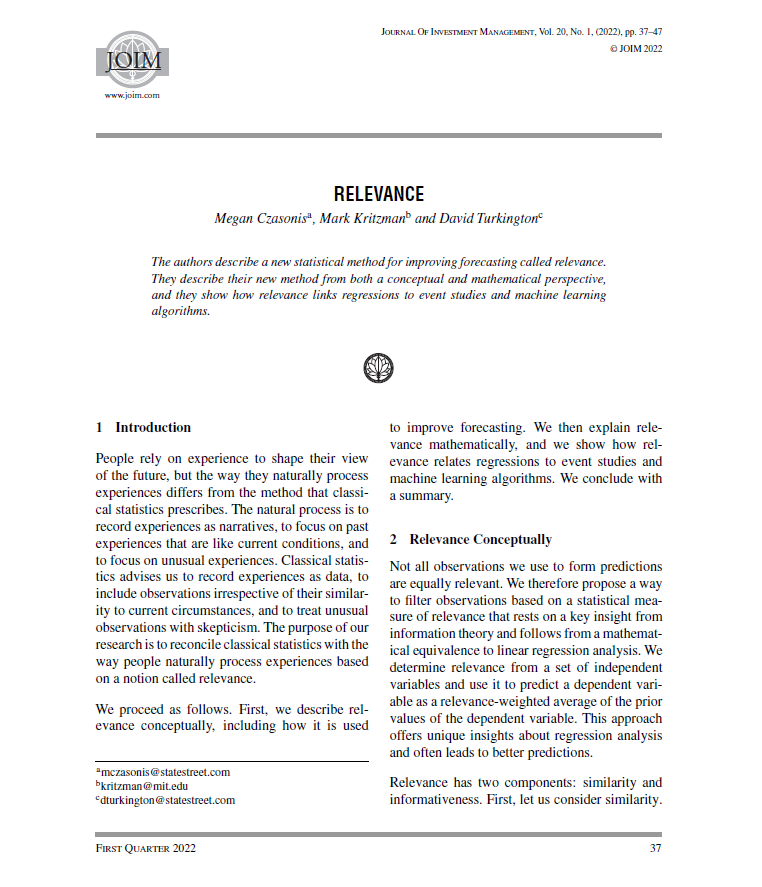
Feb 4, 2022
Relevance
By Megan Czasonis, Mark Kritzman, and David Turkington Published in the Journal of Investment Management, First Quarter 2022 and recipient of the 2022 Harry Markowitz Award. People learn from experience and extrapolate from the relevant past to predict the future. Data-driven regression models do the same thing. To know why, we need to shift our perspective on data. Modern statistics focus on variables: carefully selecting the right ones, measuring their impact and testing their significance. ...
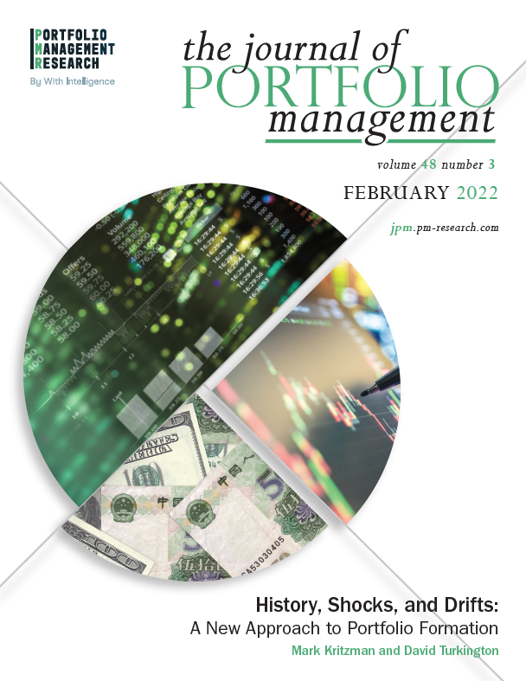
Jan 13, 2022
History, Shocks, and Drifts: A New Approach to Portfolio Formation
By Mark Kritzman and David Turkington. Published in the Journal of Portfolio Management, February 2022. Portfolios face many risks. Some may be gradual but persistent, like climate change and demographic shifts; while others happen suddenly, like pandemics or financial crises. To manage the possibilities, investors must unify their view of major events that might happen over long intervals with those that might happen along the way. The future will surely bring both, with echoes of history ...
Aug 12, 2021
The Myth of Diversification Reconsidered
By William Kinlaw, Mark Kritzman, Sébastien Page, and David Turkington. Published in the Journal of Portfolio Management, August 2021. Recipient of the Journal of Portfolio Management's 2021 Bernstein Fabozzi /Jacobs Levy Outstanding Article Award. To account for asymmetric correlations, investors must measure them correctly. Many don’t. Diversification is one of the core principles of investing. Unfortunately, it tends to disappear when it is needed most and turn up again when it is unwanted. ...
Feb 1, 2021
The Stock Bond Correlation
By Megan Czasonis, Mark Kritzman, and David Turkington. Published in the Journal of Portfolio Management, February 2021. We propose a more reliable way to predict the stock-bond correlation, focusing on relevant economic variables during relevant periods in history. Despite its importance for portfolio returns, the stock-bond correlation is often predicted in an unreliable way. The most common approach is to assume that what happened recently will persist into the near future, though this ...
Jan 29, 2021
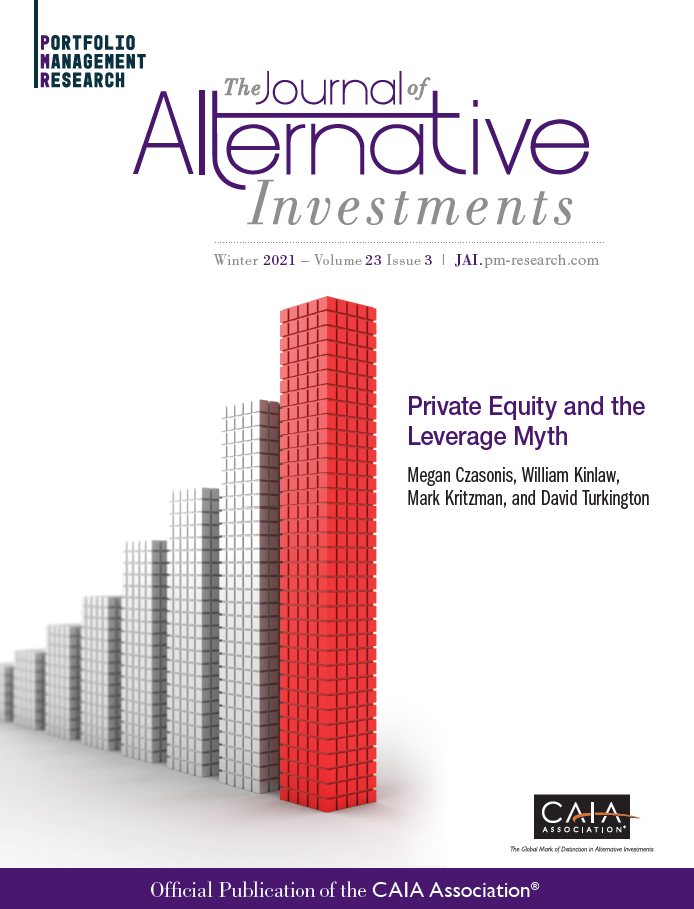
Private Equity and the Leverage Myth
By Megan Czasonis, William Kinlaw, Mark Kritzman, and David Turkington. Published in the Journal of Alternative Investments, Winter 2021. Conventional wisdom regarding the way leverage affects volatility is incorrectly leading private equity investors to dramatically overestimate risk. A fundamental precept of corporate finance is that the volatility of a firm's equity is positively related to its leverage with one-to-one correspondence. Following this logic, investors commonly estimate the ...
Dec 16, 2020
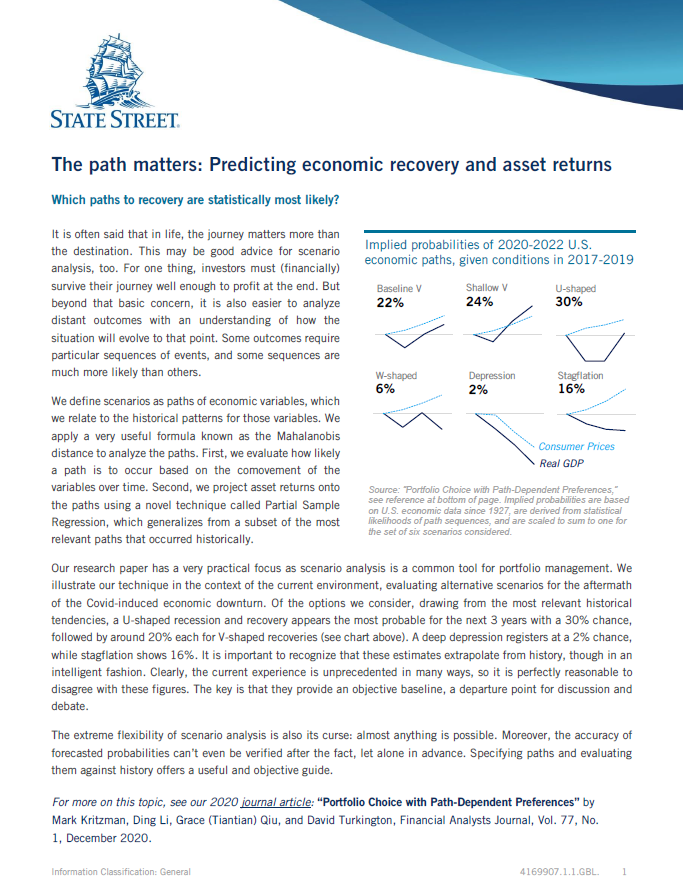
Portfolio Choice with Path-Dependent Preferences
By Mark Kritzman, Ding Li, Grace (Tiantian) Qiu, and David Turkington. Published in the Financial Analysts Journal, December 2020. We show why mapping sequences of economic outcomes leads to a richer understanding of scenarios, probabilities and portfolio returns. Conventional methods of scenario analysis are often oversimplified, focusing only on outcomes and ignoring what happens along the way. We propose that investors define scenarios as paths of economic variables, which are compared ...
Sep 1, 2020
Addition by Subtraction: A Better Way to Forecast Factor Returns (and Everything Else)
By Megan Czasonis, Mark Kritzman, and David Turkington. Published in the Journal of Portfolio Management, September 2020. Similar to how economists might think about past events, regression models consider historical relevance when generating predictions. Censoring the least relevant periods can improve their predictive power. Any introductory statistics course teaches that when it comes to regression analysis, the more data the better. This is because larger samples should produce more reliable ...
Mar 1, 2020
Enhanced Scenario Analysis
By Megan Czasonis, Mark Kritzman, Baykan Pamir, and David Turkington. Published in the Journal of Portfolio Management, March 2020. We show how to compute data-driven probabilities for future economic scenarios, adding quantitative rigor to scenario analysis while preserving its intuitive appeal. Many investors use economic scenario analysis as an intuitive way to inform their asset allocation. With scenario analysis you can model almost anything – but this flexibility is as much a blessing as a ...
Mar 1, 2015
The Divergence of High- and Low-Frequency Estimation - Implications for Performance Measurement
By Will Kinlaw, Mark Kritzman, and David Turkington. Published in the Journal of Portfolio Management, Spring 2015 and recipient of the 2015 Bernstein Fabozzi/Jacobs Levy Outstanding Article Award. We document the distortion that non-zero lagged correlations introduce to the Sharpe ratios within a universe of hedge funds, the information ratios of a universe of mutual funds, and the performance of risk parity strategies.
Sep 1, 2014
The Divergence of High- and Low-Frequency Estimation: Causes and Consequences
By William Kinlaw, Mark Kritzman, and David Turkington Published in the Journal of Portfolio Management, 40th Year Special Anniversary Issue and recipient of the 2014 Bernstein Fabozzi/Jacobs Levy Outstanding Article Award. Financial analysts are often surprised by the extent to which assets that are thought to be strongly correlated diverge over time. We analyze the causes and consequences of the divergence of high- and low-frequency estimation, and we present a framework for constructing portfolios ...
Dec 1, 2013
Liquidity and Portfolio Choice: A Unified Approach
By William Kinlaw, Mark Kritzman, and David Turkington. Published in the Journal of Portfolio Management, Winter 2013. Our research on “Liquidity and Portfolio Choice” provides a framework for asset owners to evaluate the benefits of liquidity and costs of illiquidity, and implications for strategic asset allocation. READ THE 1-PAGE SUMMARY
Dec 1, 2013
Liquidity and Portfolio Choice: A Unified Approach
By William Kinlaw, Mark Kritzman, and David Turkington. Published in the Journal of Portfolio Management, Winter 2013. Our research on “Liquidity and Portfolio Choice” provides a framework for asset owners to evaluate the benefits of liquidity and costs of illiquidity, and implications for strategic asset allocation. READ THE 1-PAGE SUMMARY

1. Peter L. Bernstein Award for Best Article in an Institutional Investor Journal in 2013; Bernstein-Fabozzi/Jacobs-Levy Award for Outstanding Article in the Journal of Portfolio Management in 2006, 2009, 2011, 2013 (2), 2014, 2015, 2016, 2021; Graham & Dodd Scroll Award for article in the Financial Analysts Journal in 2002 and 2010. Roger F. Murray First Prize for Research Presented at the Q Group Conference in 2012, 2021, 2023. Harry M. Markowitz Award for Best Paper in the Journal of Investment Management in 2022, 2023. Doriot Award for Best Private Equity Research Paper in 2022.